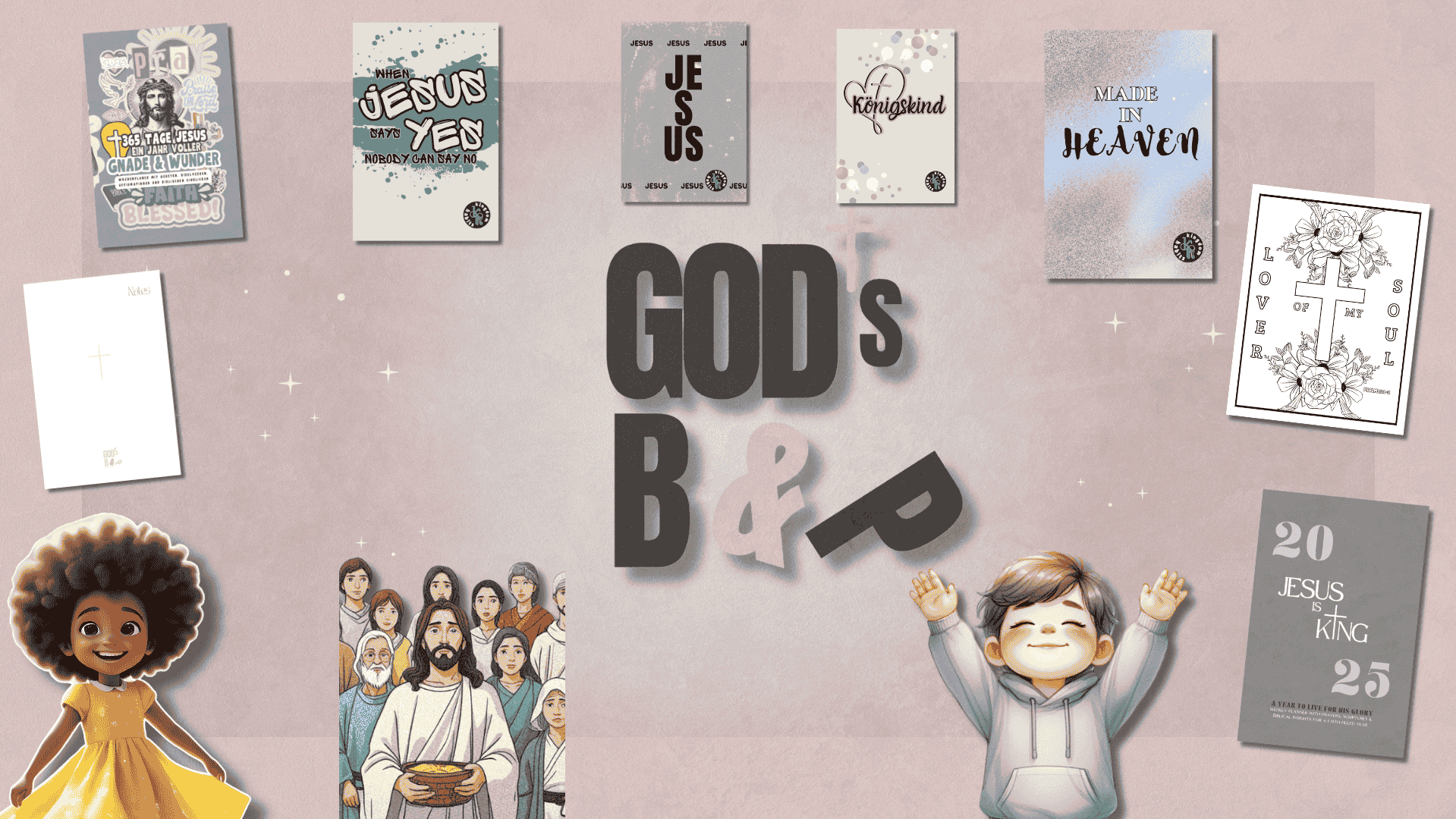
Christian Weekly Planners for Planning Your Year With God
only for real Christians – who love Jesus and are actually following Him!
Let 2027 be diffrent. Be prepared and above all in communion with HIM!
2027 is all about THE KING OF GLORY
And because life still needs planning. There are appointments to remember, responsibilities to carry, goals to work toward, people to care for, and ordinary things that simply need to get done. But as a Christian, you may want your planner to hold more than your schedule, right?
The God’s Beauty & Peace Christian Weekly Planner is designed to help you organize everyday life while intentionally walking through the year with Jesus. Weekly planning is brought together with Scripture, prayer, biblical reflection, faith and habit tracking, goals, declarations, answered prayers, and space to remember what God teaches and does throughout the year.
It is not about becoming perfectly organized or turning your relationship with God into another checklist. It is about remembering to return to Jesus; in your plans, your decisions, your habits, your prayers, your goals, and the ordinary weeks that make up a year.
Track your walk—not your perfection.
[Explore the 2027 Christian Planner]
More Than a Christian Planner With Bible Verses
A Bible verse printed beside a calendar can be encouraging. But we wanted Scripture to be more than decoration around your schedule.
The Christian Weekly Planner from God’s Beauty & Peace is built around a different question: What would it look like to intentionally plan a whole year with God?
That means making room not only for what you need to do, but also for God’s Word, prayer, reflection, obedience, repentance, forgiveness, thanksgiving, worship, spiritual habits, family, service, goals, and the things God is teaching you along the way.
You can plan your responsibilities without making productivity the center of your life. You can set goals while remembering your dependence on God. You can track habits without treating your Christian walk as a performance. And you can record answered prayers and moments of God’s faithfulness so that what happened in January is not forgotten by December.
This is practical planning with Jesus kept intentionally at the center.
What’s Inside the Christian Weekly Planner?
Daily Bible Verses
Scripture belongs in everyday life—not only on Sunday. Daily Bible verses keep God’s Word before you as you move through work, family responsibilities, decisions, goals, challenges, and ordinary routines.
The purpose is not to rush through another spiritual task. The verses provide regular opportunities to stop, read, remember, pray, and bring your attention back to God in the middle of real life.
Weekly Scripture
Each week also includes biblical focus beyond the daily verses. A weekly passage gives you something to return to throughout the week: something you can read slowly, pray through, think about, and carry into your decisions.
Instead of keeping Bible reading completely separate from planning, Scripture becomes part of the rhythm in which you approach the days ahead.
Monthly Biblical Themes
Every month has a biblical theme and main Scripture. These themes create a spiritual thread through the year, helping you spend more than a single morning thinking about subjects found in God’s Word.
You can return to the month’s Scripture as you pray, plan, reflect, and notice what God is teaching you.
Scripture-Based and Personal Faith Declarations
The planner includes space for Scripture-based declarations as well as personal faith declarations.
The purpose is not positive thinking detached from Scripture, nor an attempt to control outcomes with words. It is an opportunity to intentionally bring your thoughts and words back to biblical truth and to record what you are choosing to believe, remember, pray, and stand on before God.
Prayer and Reflection
Planning can easily become a conversation with yourself: What do I need to accomplish? What do I want next? What am I behind on?
A Christian planner should make room for a different conversation.
Prayer and reflection sections give you space to bring your plans before God, write what is on your heart, reflect on what needs attention, and record what you are learning.
Some weeks may contain pages of thoughts. Other weeks may contain only a few words. The point is not how much you write. The point is remembering to come back to Him.
Faith & Habit Tracking
The planner provides space to track areas of your spiritual and everyday life, including:
- Bible reading
- Prayer
- Repentance
- Forgiveness
- Praying in tongues
- Praise and worship
- Thanksgiving
- Speaking Scripture
- Communion
- Exercise
- Personal habits
- Family time
- Serving or helping others
But this tracker comes with an important reminder: Track your walk—not your perfection.
These boxes are not a spiritual scorecard. You do not earn God’s love by filling them in, and an unfinished week does not mean you have failed Him.
Use the tracker as a simple way to notice your rhythms. Where have you been consistent? What have you neglected? Where might God be drawing your attention again?
Then begin again.
Weekly Check-Ins
Weeks move quickly. Without reflection, one can disappear into the next.
Weekly check-ins create a regular opportunity to look back before moving forward. Notice what happened. Consider what you learned. Recognize areas that need prayer or change. Remember where you saw God’s help. Then enter the next week intentionally rather than simply carrying unfinished busyness into Monday.
Remember What God Has Done
How many prayers have you prayed and later forgotten? How many times has God provided, corrected, protected, taught, strengthened, redirected, or answered—and months later the details have faded?
The planner gives you space for answered prayers and “God did it” moments so you can build a written record of His faithfulness throughout the year.
Write down the prayers that were answered. Write down the unexpected provision. Write down the lesson you do not want to forget. Write down the breakthrough, the correction, the open door, the closed door, and the moment a Scripture suddenly became personal.
At the end of the year, you will have more than a record of appointments. You will have pages that help you remember the year you walked through with God.
Goals, Family, Service & Everyday Life
Faith does not exist outside ordinary life. That is why the planner also makes room for goals, family time, serving and helping others, exercise, personal habits, responsibilities, and practical planning.
The aim is not to divide your life into “spiritual” and “normal” sections. Jesus is Lord of all of it.
Your schedule, relationships, work, health, service, goals, rest, and private walk with God all belong in the same life.
Revelations & Notes
Sometimes you need somewhere to write down what you do not want to lose. A Scripture stands out. A prayer changes direction. Something becomes clear during worship. You recognize a pattern. God’s Word corrects an attitude. You learn something you want to remember six months from now.
The planner includes space for revelations and notes so those moments do not have to disappear into loose pieces of paper, different notebooks, or your phone.
Track Your Walk—Not Your Perfection
A Christian habit tracker can become unhealthy if it turns into a measure of spiritual worth. That is not the purpose of this planner.
Prayer is not a box you check so God will love you more. Reading your Bible does not purchase His favor. Missing a day does not require you to abandon the whole week.
The planner is there to help you pay attention.
If your prayer life has quietly disappeared from your routine, you can notice. If thanksgiving has been replaced by constant worry, you can notice. If weeks have passed without meaningful time in Scripture, you can notice.
And instead of condemning yourself, you can return to Jesus.
Track your walk—not your perfection.
The goal is not a flawless planner. The goal is an intentional life with God.
Christian Goal Setting With God
Goals can be useful. They give direction to ideas, turn intentions into action, and help us steward our time.
But Christian goal setting begins with a deeper question than: “What can I achieve this year?”
It also asks: “Lord, what do You want me to do?”
The Christian Weekly Planner gives you space to think seriously about your goals while holding them before God rather than treating your plans as independent from Him.
Some goals will require discipline. Some will require patience. Some may change. Some may need to be surrendered altogether. And some may be so far beyond what you can accomplish by your own strength that they keep bringing you back to prayer.
That idea becomes especially important in the 2027 planner.
Meet the 2027 Christian Weekly Planner
The Year of the King of Glory
The theme of the 2027 Christian Weekly Planner is:
THE YEAR OF THE KING OF GLORY
Its key passage is Psalm 24:7–10, with the call to lift up the gates for the King of glory to come in.
The theme invites you to consider a deeply personal question throughout 2027:
Where does Jesus need to be welcomed more fully into my life?
Your plans? Your habits? Your relationships? Your priorities? Your fears? Your goals? Your time? Your home? Your thought life?
Rather than planning a year around self-improvement alone, the 2027 planner continually brings your attention back to the King.
The aim is not simply to have Jesus somewhere in your plans. It is to intentionally walk through the year with Him.
[Explore the 2027 Christian Planner]
12 Biblical Themes for 2027
The year unfolds through monthly biblical themes that invite focused Scripture study, prayer, reflection, and practical response.
- A New Thing — looking to God as you enter a new season.
- Repentance — allowing God to expose what needs to change and turning back to Him.
- Miracle — remembering that nothing is too difficult for God while leaving the outcome in His hands.
- Preparation — becoming willing to prepare before you can see everything ahead.
- Transformation — allowing God’s truth to change more than external circumstances.
- Restoration — bringing broken, lost, or neglected areas before God.
- Good Speed — moving forward with God rather than simply moving faster.
- Rest in Jesus — remembering that constant activity is not the same as faithfulness.
- Resurrection — fixing your attention on the resurrection of Jesus Christ and the life found in Him.
- Oil in the Lamp / Readiness — living awake, prepared, and attentive rather than spiritually careless.
- Tearing Down Idols and Strongholds — honestly examining what has been given a place that belongs to God.
- Divine Intervention — praying and trusting God in circumstances that cannot be solved through human effort alone.
These themes are not predictions about what must happen in a particular month. They are biblical subjects designed to guide Scripture-centered prayer, reflection, and intentional living throughout the year.
27 Impossible Goals With God
The 2027 planner includes a special section for 27 Impossible Goals.
These are not meant to be twenty-seven bigger versions of an ordinary to-do list. They are goals that cause you to recognize your dependence on God.
An “impossible goal” may be something you cannot accomplish simply by working harder, organizing better, or relying on your own ability. It brings you into prayer. It may require courage, obedience, provision, wisdom, changed circumstances, help from others, or doors only God can open.
Writing an impossible goal is not a guarantee that God will do exactly what you have written. It is an invitation to pray, listen, act faithfully, surrender the outcome, and record what happens.
Some goals may be fulfilled differently from what you expected. Some may change. Some may remain unanswered for longer than a year.
The value is not in pretending you can control the future. It is in refusing to build your entire future around what you can accomplish without God.
[Start 2027 With Jesus at the Center]
Looking Ahead: The 2028 Christian Planner
The larger theme of the 2028 Christian Weekly Planner is:
THE KING IS COMING
January begins with Noah and the call to readiness:
THE FLOODS ARE COMING — GET READY / BUILD
The biblical foundation includes Matthew 24:37–39 and Hebrews 11:7.
This theme is not a prediction of a literal worldwide flood. The emphasis is on Noah’s readiness, obedience, faith, and willingness to respond to God’s instruction before he could see the evidence before him.
It asks questions that remain relevant for Christian life:
- Will I obey God when obedience requires preparation?
- Will I act on His Word before circumstances make everything obvious?
- Am I spiritually awake?
- Am I building what God has asked me to build?
- Am I ready to follow when faith requires action?
Who Is This Christian Planner For?
This planner is for Christians who want practical organization without separating planning from their walk with Jesus.
It may be especially useful if you want to:
- Keep Scripture visible throughout your week
- Become more intentional about prayer
- Organize responsibilities while keeping Jesus at the center
- Build consistent spiritual and personal habits
- Set goals prayerfully
- Remember answered prayers and God’s faithfulness
- Make space for repentance, forgiveness, worship, thanksgiving, and Communion
- Reflect on what God is teaching you
- Keep family, service, health, goals, and spiritual life in one place
- Look back at the end of the year and remember more than completed tasks
You do not need to be naturally organized. You do not need a perfect morning routine. And you do not need to fill every space on every page.
How to Use Your Christian Weekly Planner
There is no single perfect routine, but a simple rhythm can help.
1. Begin the Month With Scripture and Prayer
Read the monthly theme and main Scripture before filling the month with plans. Ask God what deserves your attention and whether anything needs to change.
2. Plan the Practical Things
Add appointments, responsibilities, deadlines, family commitments, goals, and tasks.
Christian planning is still planning. Writing down an appointment does not need to become complicated or overly spiritual.
3. Read the Week’s Scripture
Before rushing into your task list, spend time with the biblical passage for the week. Carry it with you. Return to it. Pray through it.
Let Scripture speak into your week instead of allowing your schedule to have the first and final word.
4. Use the Tracker Honestly
Record your rhythms without performing for the page. The tracker exists to help you notice, not condemn.
5. Write Down What God Does
Do not wait until December to try to remember eleven months of answered prayer. Record “God did it” moments as they happen.
6. Complete Your Weekly Check-In
At the end of the week, look back. What happened? What did you learn? What needs prayer? What needs repentance or forgiveness? Where did you see God’s faithfulness?
What should you carry into next week—and what should you leave behind?
Then begin again.
Why Plan Your Year With God?
A planner cannot tell you God’s will. It cannot replace Scripture. It cannot replace prayer. It cannot replace the Holy Spirit. And owning a Christian planner does not automatically produce a closer relationship with Jesus.
It is simply a tool.
But good tools can help us remember what matters.
A planner can remind you to stop before another week disappears. It can keep Scripture in front of you. It can give your prayers somewhere to live on paper. It can show you patterns you might otherwise miss. It can preserve the story of answered prayers that you might otherwise forget. It can help you bring practical responsibilities and spiritual priorities into the same place.
And at the end of a year, its pages can tell a story that an ordinary calendar cannot:
Not only where you went and what you did, but also what you prayed, what you learned, where you grew, what God brought you through, and how He was faithful along the way.
That is why we plan with God.
Not because we know what the year will hold. Because we know Who we want to walk through it with.
Christian Planner FAQ
What Is a Christian Planner?
A Christian planner combines practical planning with intentional space for faith. Depending on the planner, that may include Scripture, prayer, reflection, gratitude, Bible reading, spiritual habits, and Christian goal setting.
The God’s Beauty & Peace Christian Weekly Planner combines weekly organization with daily Bible verses, weekly Scripture, monthly biblical themes, prayer, declarations, reflection, faith and habit tracking, goals, answered prayers, weekly check-ins, and space to record what God teaches throughout the year.
How Is a Christian Planner Different From a Regular Planner?
A regular planner primarily helps you manage dates, appointments, tasks, and goals.
This Christian planner still helps with practical organization, but intentionally brings Scripture, prayer, spiritual reflection, habits, answered prayer, and your walk with Jesus into the same planning rhythm.
The difference is not simply that Bible verses have been added to ordinary calendar pages. The planner is designed around intentionally walking through the year with God.
Does This Christian Planner Include Bible Verses?
Yes. The planner includes daily Bible verses, weekly biblical passages, monthly main Scriptures, and Scripture-centered themes.
The purpose is to keep God’s Word present throughout the way you plan and reflect on your year.
Is This a Prayer Planner Too?
Prayer is an important part of the planner, but this is broader than a dedicated prayer journal.
It combines prayer with weekly planning, Scripture, reflection, goals, spiritual disciplines, habit tracking, answered prayers, family life, service, and practical responsibilities.
If you want prayer to remain connected to everyday planning rather than living in a completely separate notebook, this combination may be especially helpful.
Can I Use the Planner for Bible Reading and Spiritual Growth?
Yes. Bible reading is included among the areas you can track, and Scripture runs throughout the planner.
There is also space for reflection, revelations, notes, declarations, prayer, repentance, forgiveness, worship, thanksgiving, Communion, and other parts of Christian life.
The planner does not replace Bible study. It gives you a practical place to integrate what you are reading and learning with everyday life.
Is This a Christian Planner for Women?
Women can absolutely use it, including women balancing work, family, ministry, home life, study, or other responsibilities.
However, the purpose of the planner is centered on walking with Jesus rather than on a women-only planning method.
Can Christian Moms Use This Planner?
Yes. The planner has space for practical weekly planning as well as space for prayer, habits, goals, Scripture, and reflection, which can make it useful for moms managing many different responsibilities.
You do not need to complete every section perfectly for the planner to be useful during a busy season.
Does the Planner Include a Christian Habit Tracker?
Yes. You can track areas including Bible reading, prayer, repentance, forgiveness, praying in tongues, praise and worship, thanksgiving, speaking Scripture, Communion, exercise, personal habits, family time, and serving or helping others.
The philosophy behind the tracker is “Track your walk – do not try to be perfect.”
It is intended to help you notice your rhythms, not measure your worth before God.
Can I Use This Planner for Christian Goal Setting?
Yes. Goals are part of the planner, and the 2027 edition also includes 27 Impossible Goals—goals that intentionally cause you to recognize your need for partnership with God rather than relying only on personal ability.
They are not guarantees of particular outcomes. They provide a framework for prayer, faithful action, dependence on God, and surrender.
What Is the Theme of the 2027 Christian Planner?
The 2027 theme is The Year of the King of Glory, centered on Psalm 24:7–10.
Throughout the year, the planner encourages you to open every area of life to Jesus and intentionally walk with Him through monthly biblical themes including repentance, preparation, transformation, restoration, rest, readiness, resurrection, and divine intervention.
How Can I Plan My Year With God?
Begin with Scripture and prayer before filling every available space with your own plans.
Bring goals and decisions before God. Keep returning to His Word. Pay attention to your habits. Make room for repentance and obedience. Record answered prayers and lessons. Reflect regularly rather than waiting until the end of the year.
And remember that planning with God includes being willing for your plans to change.
Shop the Christian Weekly Planners
You have responsibilities to organize. You have goals you want to pursue.
But you also have prayers you do not want to forget, Scriptures you want to carry with you, lessons you want to remember, and a relationship with Jesus that matters more than completing a to-do list.
Bring them together.
Choose the Christian Weekly Planner for the year ahead and make space to plan, pray, remember, reflect, and intentionally keep returning to Jesus.
Plan your year with God.
[Explore the 2027 Christian Planner]
[Shop the Christian Weekly Planners]